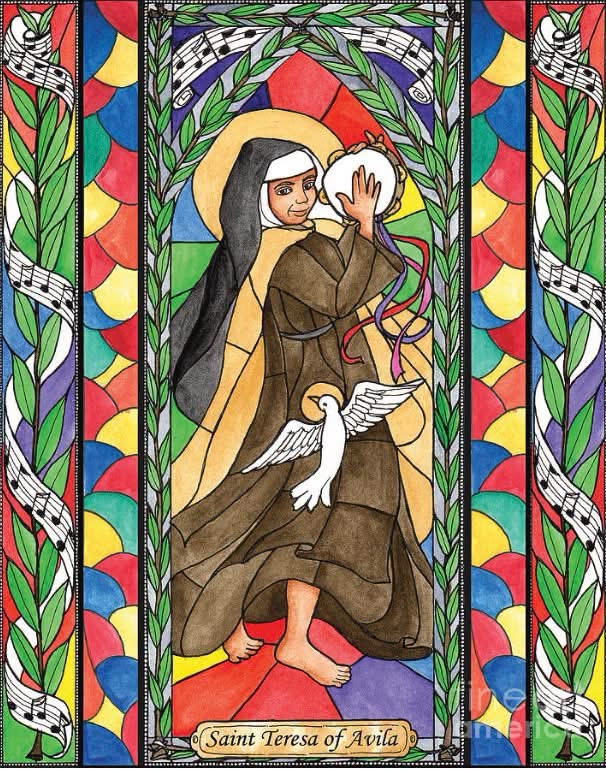
It seems like a lifetime ago when we traveled to Avila to stand before one of the giants in catholic culture. Pope Saint Paul VI declared Saint Teresa of Avila a Doctor of the Church. Today, the Church honors four women doctors, with Teresa as the first in this lineup of holy women.

She lived in the second half of the sixteenth century. She is our great heavenly friend, joining the ranks of Carmelite saints before and after her. She is also among the Church’s many great mystics and reformers.
Meeting Teresa in Rome
I stumbled upon Teresa of Avila, strolling through Rome. I visited the Cornaro Chapel in the Church of Santa Maria della Vittoria. There I was alone in this tiny, dimly lit church, gazing at Bernini’s marble statue known as the Ecstasy of Saint Teresa.

Bernini had a gift for presenting marble suspended in mid-air. Critics of Bernini saw this statue as an exaggeration of eroticism in the spiritual life. The seventeenth-century masterpiece draws the viewer into Teresa’s inner life. The statue depicts the moment Teresa felt the fiery arrow pierce her soul, infusing her with God. In Carmelite theology, this ecstasy is called the Transverberation.
Such brilliant emotionalism moves the viewer to feel God’s love for Teresa. The viewer feels the immensity of God’s love pervading her very being.
Teresa’s Castle
Teresa gave the Church her outstanding spiritual tome known as the Interior Castle. When you gaze at the city of Avila, this idea of a castle is striking. The whole town is a well-built stone fortress, and at its center is this Spanish giant! Father François-Marie Léthel, a professor at the Teresianum, commented on her tome,
The Interior Castle is a synthesis of all her spirituality. It’s a profound reflection on the words of Jesus: ‘Whoever loves me will keep my word, and my Father will love him, and we will come to him and make our dwelling with him.’ Teresa spoke of the soul as a castle with many rooms, with God dwelling at the center.
Life is a journey to the center of this castle, where we find Jesus in the inner chamber!

Here are three takeaways that I have learned from Teresa.
- This journey to the center of the soul is about self-knowledge, which is the desire for communion with God through prayer. We need prayer; without it, a person cannot enter the interior castle. Prayer is the doorway into this castle.
- The most significant room in this castle is the room of self-knowledge (1.2.8). We must visit it often. Self-knowledge takes much work and demands vigilance. Self-knowledge moves us to prayer.
- Prayer roots us in awareness of God and prompts humility. Humility “is always at work. Without it, everything goes wrong” (1.2.8). We need humility and self-knowledge to help purge us from sin so we can journey to God. Humility allows us to speak to the all-holy and completely loving God.
Teresa’s great tome takes us on a lifelong journey into the soul. In the inner chambers of our castle is the King who died for us. In the center of the castle is the King who defeated death and has prepared a place for us. Life is a journey of purging sin and our attachments to stand in his holy presence.
Saint Teresa of Avila exhorts us to see Jesus as our friend, and in that friendship, he will be with us. She said,
If Christ Jesus dwells in a man as his friend and noble leader, that man can endure all things, for Christ helps and strengthens us and never abandons us. He is a true friend .
If you are in the Sacramento area this weekend, please come to the Cathedral of the Blessed Sacrament and join us for this event!

Leave a Reply