
“To live till we die— being willing to go on learning all the way to the end— takes a great deal of emotional balance. To be amenable, to continue working through all the dimensions of life till we see their value for us is the essence of spiritual maturity.” – Joan Chittister, OSB
Joan Chittister, OSB, offers captivating insight into our spiritual growth. Her quote connects seamlessly with the Benedictine value of stability, both offering paths toward spiritual maturation.
Building on this, Benedictine stability is neither static nor outdated. For professed Benedictine monks, stability refers to a lifelong commitment to stay in a single monastic house. Such permanence roots their hearts through daily sacrifices and prayers shared within this specific community. Stability is a commitment to honestly living together while pursuing Christ, permanence that embodies consistent support and charity among the members.
This raises an important question: how does monastic stability translate for me and those outside the monastery?
For those of us living beyond monastic walls, as disciples, we accept the invitation to stay committed to God, prayer, and life in every season and storm. We stay until the lesson is learned. There is an inner energy that guides us through the valleys and hills of life. Everyone will experience the emptying of life when we lose friends and family in death, when we transition in jobs, when we experience inner collapse and need that still strength within to see us through. When we are emotionally balanced and open to lifelong learning, we can bear life in its multifaceted dimensions. We find peace in the recognition that Christ is in it all. This is stability. That is why it is fitting to consider the Benedictine value of stability today, with my young Benedictine heart.
Two Anniversaries
June 16 marks my baptism anniversary. I was baptized at Saint Patrick’s Church in San Francisco. On this day 42 years ago, my parents, accompanied by my godparents, brought me to the baptistry and claimed me for Christ and his Church. This particular year strikes a chord in my heart. Last week, I provided music for my godfather’s funeral liturgy. The one who brought me to the waters of baptism, I accompanied as we commend him to our loving God. In life and in death, we are the Lord’s.
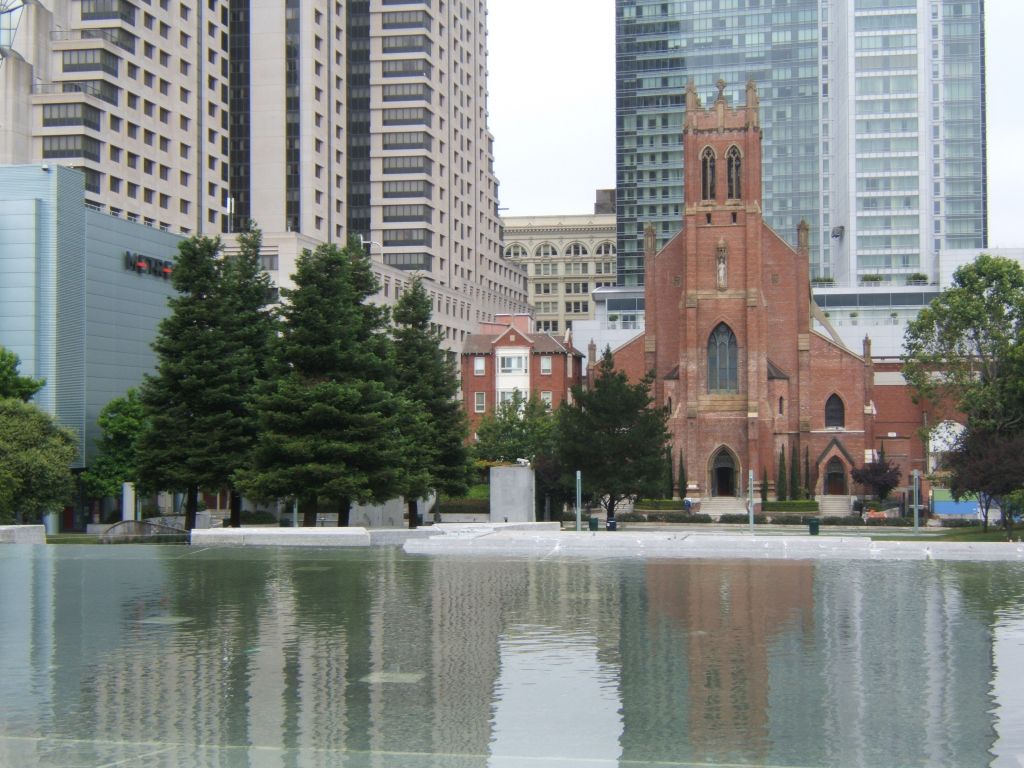
Along with my baptism, this day also marks the third anniversary of becoming an oblate of Mount Angel Abbey.
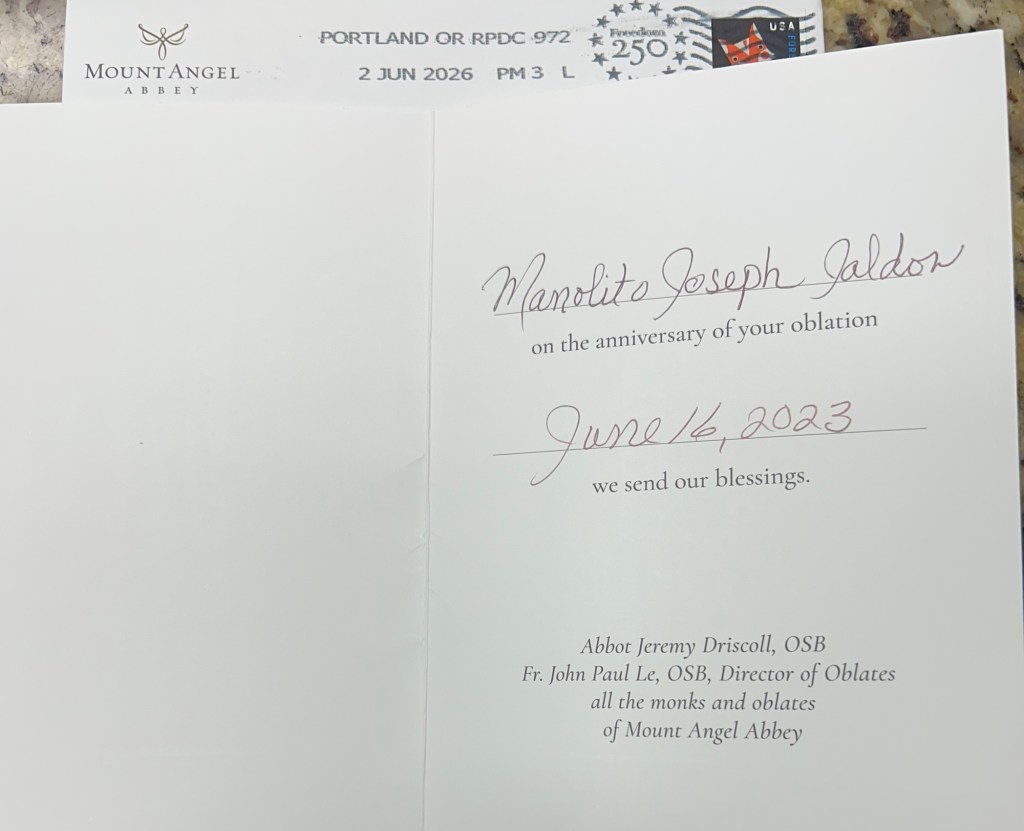
You may wonder: What is a Benedictine Oblate?
To make an oblation—an act of offering oneself—is to offer your total life as a gift to God. A Benedictine oblate is a layperson who formally affiliates with a particular monastery, embracing Benedictine values of work and prayer in daily life while living outside the monastery. Oblation strengthens baptismal commitment and grafts you to a particular Benedictine monastery, embracing its long-standing Benedictine values of work and prayer. An oblate makes a formal and permanent commitment to a monastery with a life centered on lectio, work, and liturgy, remembering the monks of Mount Angel insofar as our state in life permits. These values are lived out in our parishes, families, and workplaces.
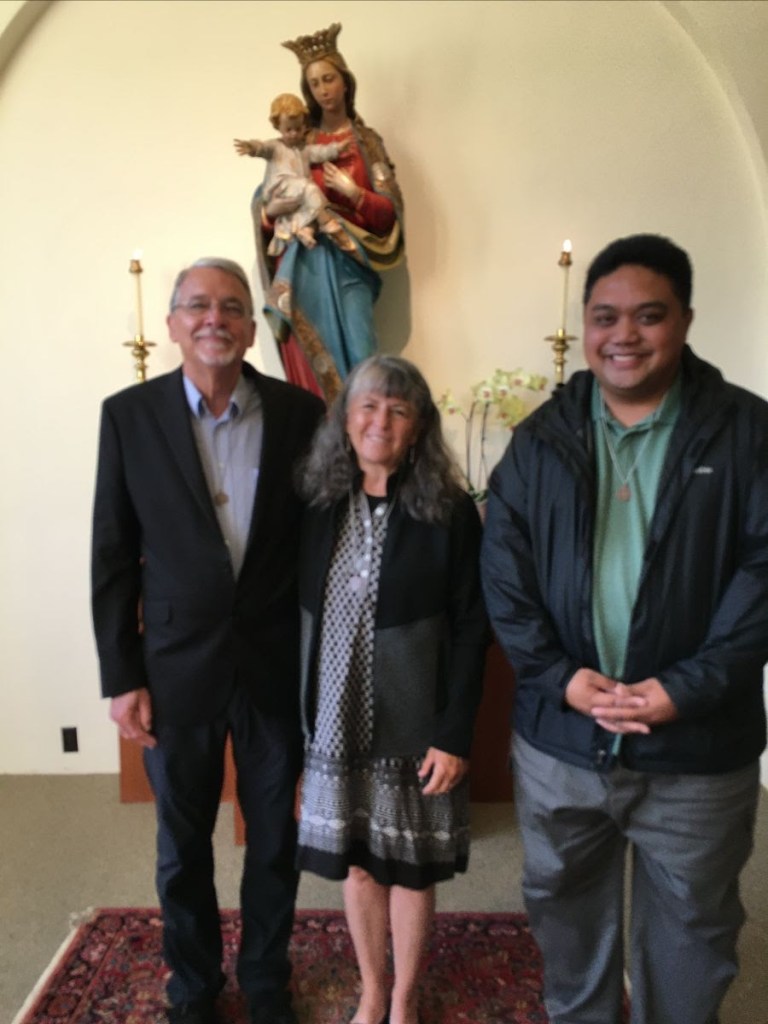
and Laura “Elizabeth” Kelly. On this day, I was given the name Joseph.
He is my patron as I live this oblation to God at Mount Angel Abbey.
Becoming a Mount Angel oblate is a year-long journey of spiritual growth and self-discovery. After meeting the Director of Oblates, I spent a novice year attending monthly gatherings, either in person or online, where monks discussed the life of Benedict, the Liturgy, and the Rule.
After a year of discernment, reflection, and prayer, I made a retreat to decide if Mount Angel Abbey should be my spiritual home. This period is crucial for making a decision rooted in faith and a response to God’s call.
I feel deeply grateful that I have found a spiritual center, a place I can call home after such a long, well-lived journey.
 Enlarge my heart
You are welcome to leave a reply.