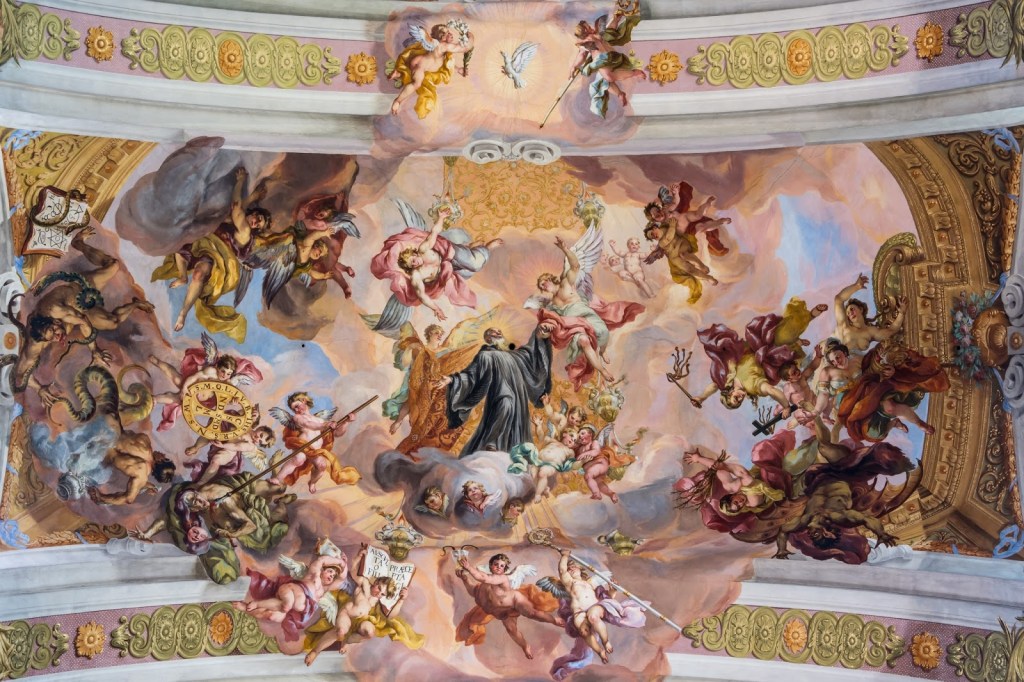
Today we celebrate the death of Saint Benedict. Also known as the Transitus, Latin for “passing from one state to the next” or “being in transit.” Transitus draws on sentiments we pray at every Funeral Liturgy: “in death life has changed, not ended.”
The Transitus is one of two days that honor the Father of Western Monasticism, with his second feast day on July 11, which dates to 1964, when Benedict was declared Patron of Europe at the rededication of the Church at Monte Cassino. July 11 is the Feast of St. Benedict for the Universal Church.
The artwork above is The Triumphal Way of St Benedict by Johann Michael Rottmayr, dated in 1722. It is a fresco on the ceiling of Melk Abbey in Austria. True to baroque form, the masterpiece erupts from the ceiling, giving the viewer the sense that heaven has burst open and we are taken up into the scene.
As we contemplate this masterpiece, what does Benedict’s death teach us? Gregory gives a plain account from his hagiography. He says,
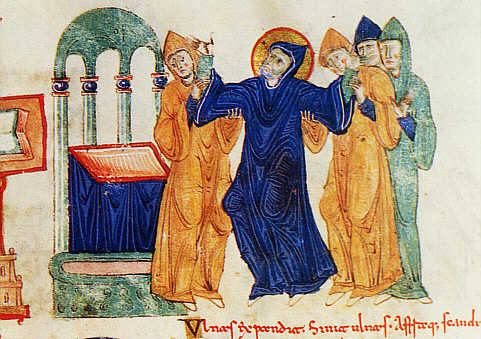
Six days before his death, he commanded that his grave be opened. Soon he was seized with fever, and he was exhausted by its burning heat. He became weaker as the days went by, and on the sixth day he had his disciples carry him into the oratory. There he fortified himself for death by receiving the Body and Blood of the Lord. Then, with his weak body held up by his disciples, he stood with his hands raised toward heaven and breathed forth his last as he prayed (Chapter 37.2).
Two details are striking. First, Benedict is surrounded by his brothers. He does not die alone. This highlights the reality that we are on a journey together to everlasting life. The second detail is that he receives the Body and Blood of the Lord. After years of lectio and work, Benedict receives lasting food for the journey to meet Christ face-to-face.
Benedict taught about death in his Rule. He stated that patience prepares us well for death. As lifelong monks in the monastery, they must persevere in the teachings of Christ until death and “shall through patience share in the sufferings of Christ that we may deserve also to share his kingdom” (Prologue 50).
Patience bears fruit in a life lived as a continuous Lent (RB 49). This means that we are always focused on Christ, journeying with him, dying to our ego so that we can serve others. This is a healthy way of keeping death before our eyes, always running toward what will profit us forever (Prologue 44).
The life of Saint Benedict, as reflected in the hagiography of Saint Gregory and in Benedict’s Rule, should lead us from adoration of the holy life of Benedict toward a spiritual love for Jesus. May it be so.
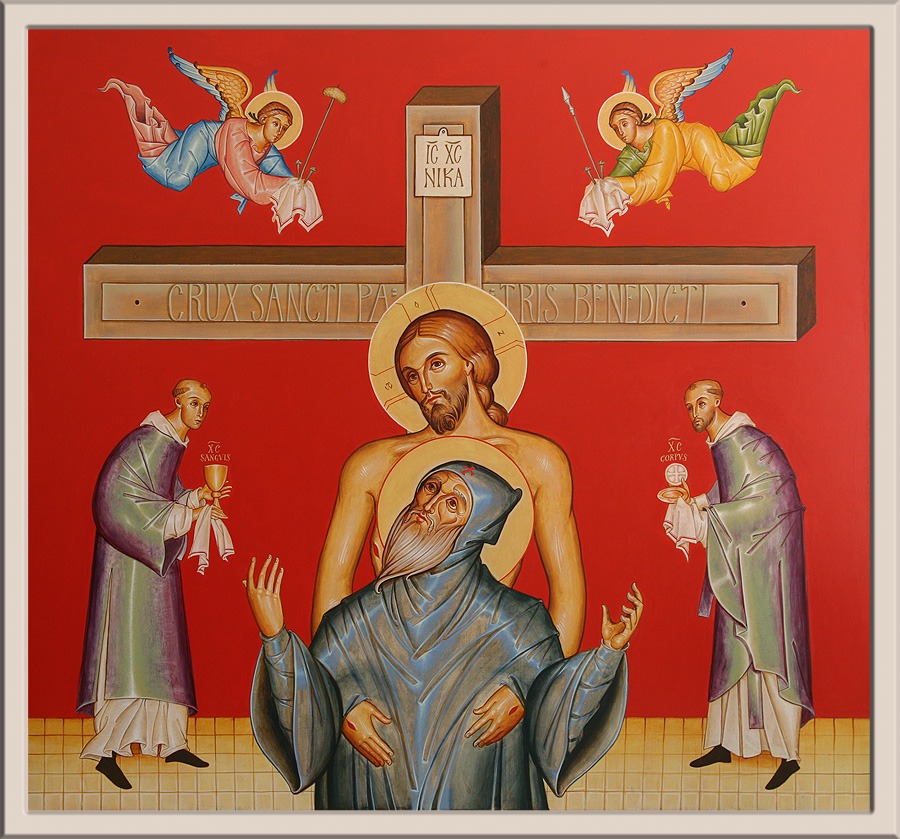
O Almighty and Ever-living God, who did this day deliver from the prison of the flesh your most holy Confessor Benedict and bear him up to heaven, we beseech you, grant your servants who are celebrating this festival forgiveness of all sins, that in the gladness wherein they are united in rejoicing at his glory, they may by his intercession before you partake also in his merits. Through Christ our Lord. Amen.
St. Benedict, Father most renowned, father most compassionate, man of venerable life, and colleague of all the Saints. Pray for us!
-Collect for the Feast of the Transitus of St. Benedict.
 Enlarge my heart
You are welcome to leave a reply.