Death is messy, ugly, and permanent. How do we even begin to imagine such separation from life and from those we love? No one can escape death, irrespective of age or health. I think of death as the great equalizer. All of us must pass through it, no matter our title, prestige, degrees, or poverty. All of us must face death. How do we make sense of this finality? Death is the message of this Sunday’s Gospel and it is also a message of life. Life in Christ.
On this final Sunday of Lent, the Gospel firmly roots us in the truth. Death will not separate us from the love of Jesus. We need Jesus, life’s great hope, to understand the passage from death to eternal life. The Catechism teaches:
The Christian meaning of death is revealed in the light of the Paschal mystery of the death and resurrection of Christ, in whom resides our only hope. The Christian who dies in Christ Jesus is “away from the body and at home with the Lord” (CCC 1681).
Christ is our hope, and we must be firmly rooted in him. While others saw Lazarus as dead for four days, Christ saw death as sleep. In the Jewish imagination, four days signify a state of absolute, irreversible death, where the soul leaves the body entirely after three days. Yet, Jesus told his disciples, “Our friend Lazarus is asleep, but I am going to awaken him” (John 11:11).
Jesus, the same Lord of life, had awoken the widow of Nain’s young Son from death (Luke 7:11-17). He awoke the 12 year-old girl and gave her life (Mark 5: 35-43). Our bodily death is sleep in God’s loving plan. He will awake us at any moment and utter the words of Ezekiel:
O my people, I will open your graves and have you rise from them, and bring you back to the land of Israel. Then you shall know that I am the LORD, when I open your graves and have you rise from them, O my people!
At the same time, Jesus faces the raw, unfiltered emotions of what we face when death separates us from those we love. He saw Mary weeping over her deceased brother, and he was “perturbed and deeply troubled.”
The Greek for perturbed is ἐμβριμάομαι. Embrimáomai means to snort with anger. In the translation above, “perturbed” is followed by “deeply troubled,” giving this sense of inner spiritual groaning. Jesus was angry at the presence of death.
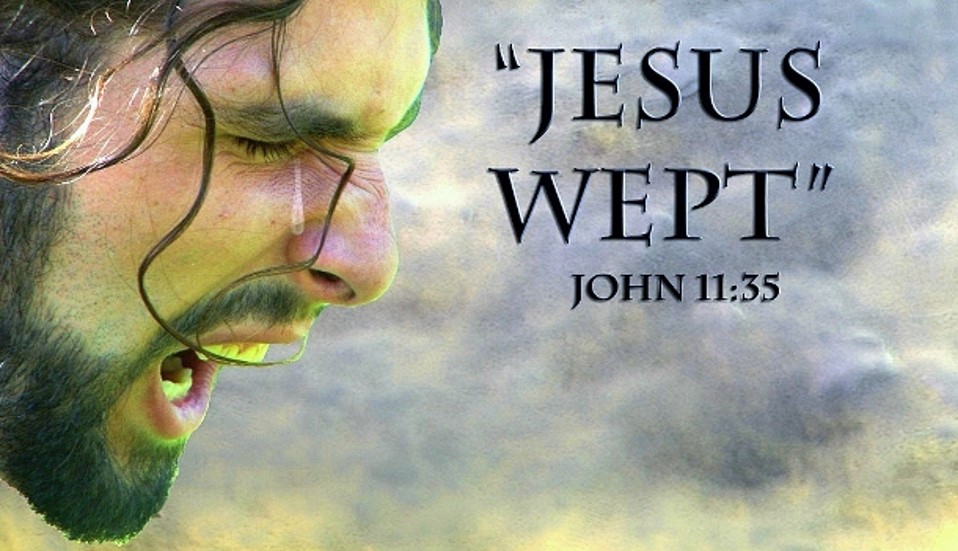
When they brought Jesus to the tomb of Lazarus, Jesus wept. He enters our sorrows as man and yet remains the Son of God, angered at the pain we experience in death.
In this moment, he declares to Martha:
I am the resurrection and the life; whoever believes in me, even if he dies, will live, and everyone who lives and believes in me will never die. Do you believe this?
This question is not only for Martha. It is a question for all of us! In the core of our being, do we confess Christ as the Resurrection and Life? Is he the one to whom we root all our hope?
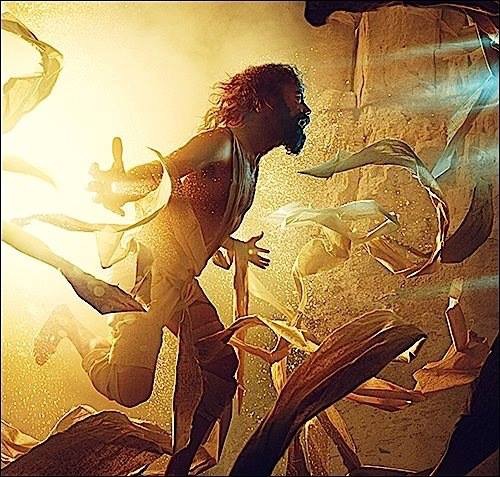
As he did for Lazarus, Jesus will also call us out of our tombs! He will call us by name! Even now, as we live. He calls us out. Pope Francis says,
He calls us insistently to come out of the darkness of that prison in which we are enclosed, content with a false, selfish, and mediocre life.
Even now as we live, Jesus calls us out of our sin into a life of abundance and joy. His constant invitation is to remove the bandages of pride that enslave us. It is a constant loving call to remove this mask of death, pride, and sin. In Christ, we see the beauty of who we are in the image of God.
A Thought on the Death of Jesus
In his book, Awesome Glory: Resurrection In Scripture, Liturgy, and Theology, Abbot Jeremy gave me insight into the death of Jesus and its relation to our ultimate destiny.
The dialogue between Father and Son is who God is. The Son cries, uttering Father throughout his ministry. The Father looks on the Son and calls him Beloved. At all times, the Holy Spirit is present in this dialogue. Even at his approaching death, in his suffering, he cries a prayer of abandonment, yet ultimately gives his life over to the Father.
This exchange of names takes place not only in time, but also in death. This exchange of names breaks the bonds of death. The Father raises his Son from death.
How about us? We can face our own death and cry out to God as Father. God looks tenderly at us as we cross the valley of death, and he utters My Beloved.
As Easter people, we know the story! The Father will raise Jesus from his tomb! The Father will raise Jesus from the sleep of death. Jesus will utter the Father’s name and speak what is rehearsed on our lips as we wake each morning. He declares, “Lord, open my lips, and my mouth shall declare your praise.” This is our hope.
 Enlarge my heart
You are welcome to leave a reply.