Throughout these monthly reflections, we have considered liturgy and what happens at Mass. Today’s post concludes these reflections.
The most moving moment in my teenage life was being an altar server for the Cardinal Archbishop of Cebu when he visited San Francisco. It was such a humbling experience in my teenage life. Liturgy has always been a source of life and love for me for it is through it that I encounter Jesus.
Everything about liturgy transmits what it means to be fully alive! Our Sunday worship is more than an independent event on the weekend or something we do to fulfill a holy obligation.
Let’s recapitulate what we have explored this past year. The liturgy has four main components: the Introductory Rite, the Liturgy of the Word, the Liturgy of the Eucharist, and the Concluding Rites. Let me briefly describe each element and how it relates to our lives.
In the Introductory Rite, we not only assemble and gather, but we also foster a profound sense of belonging. In a sense, the Introductory Rite commences at home as we prepare our children, dress them up, gather them in the car and drive to the Church. These acts from home prepare us to worship God and transition us from the domestic Church into the assembly of the Body of Christ. In the Introductory Rite, we are not just welcomed, but we are embraced as an integral part of a larger family, a community united in faith and love.
In life, we have many moments when we experience welcome:
- We enter the world.
- We start school.
- We begin college.
- We take our initial steps into the workforce.
- We marry the love of our life.
These are all critical moments of welcome, reflecting what happens at Mass.
In the Liturgy of the Word, we actively engage with the stories, finding echoes of our own experiences in the biblical narratives. In the Old Testament, the center is found in the Exodus event which foreshadows the event of Christ in the New Testament.
Everything that God has said to a people in a certain time, is made present to us in our hearing and draws us deeper into the mystery of God’s personal and deliberative intention to draw near to us. At the center of the Liturgy of the Word is the Risen Christ whose resurrection is not only a historical moment, but “the particular assembly is the place, the time, the people, the moment in history in which Christ is risen.”
Throughout our lives, we gather around our elders, hear their stories, and relive their joys and struggles. We share stories around a table to tell our parents about the many events of our day. Listening to each other tell stories enriches our lives. The art of listening is a recognition that we care for each other along this pilgrim journey, have mutual respect for all, and that our lives are always best lived within a community of people. Equally important as listening is eating together. Eating together fulfills the Lord’s command, “Do this in memory of me.” Eating together in Christ is now the focus of the Liturgy of the Eucharist.
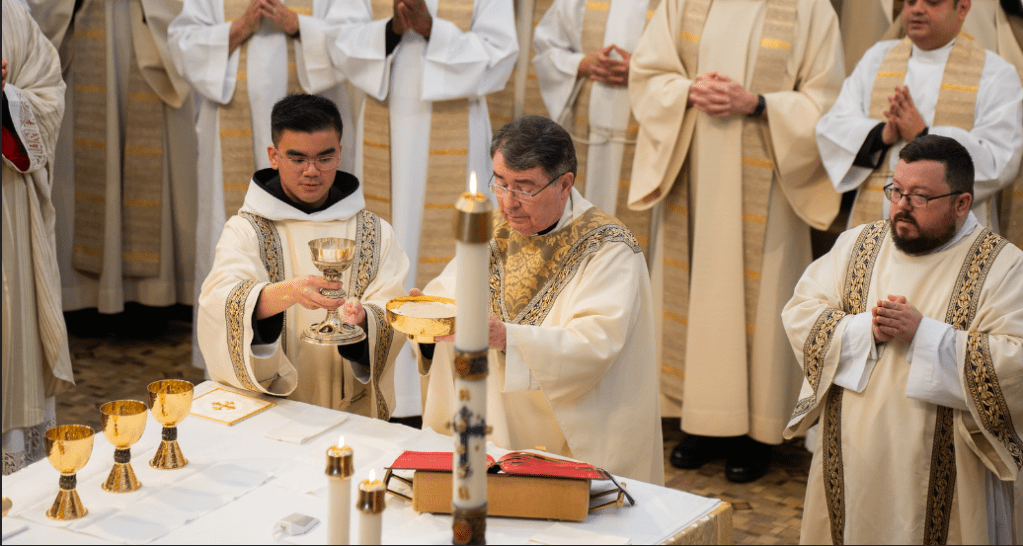
In the Liturgy of the Eucharist, we don’t just give thanks, eat, and drink; we do it as a unified community. As bread and wine are prepared for our reception we keep in mind that “they are in fact the product of the cooperation between the Creator and human beings.” A farmer must care for wheat, and someone must crush grapes in their vineyards. These gifts take time to mature as they are prepared for our reception. Gifts are brought to the altar and represent the work of our hands, the labor of our week, and the joys and sorrows known only to God. We offer these gifts to the priest. On our behalf, the priest, standing in the person of Christ, offers these same gifts to the Father through the Holy Spirit. These gifts are then returned to us and given to us in a new and glorified way. These gifts become Christ himself, who is blessed, broken, and shared. We receive not only holy gifts but the complete sacrifice of praise that the Son makes to the Father in the Holy Spirit. We are not just caught up in this divine moment of immense love in the Trinity, but we are united in it as a community, a family of faith sharing in the body and blood of Christ.
One of the most intimate moments of the human experience is those shared at the table. Loved ones labor in the kitchen and prepare a table where we can dine with them. A prepared meal expresses our deep love for each other and the intention that we are wanted by each other. It is a unique sharing of our lives and of being in communion.
The Concluding Rite is the shortest in our worship experience. We are sent from the House of God into the world to be the Lord’s presence in a world that hopes to meet him. We are brothers and sisters in communion with each other sent into the world to announce the good news. In our lives, there will be many moments in which we say farewell: we leave the house at an adult age, we graduate from college, we leave the workplace, and ultimately, the final farewell is the moment we fall into the arms of God for all eternity. The Concluding Rite is a rehearsal to infuse us with courage for the final moment we pass from this life into the next.
To celebrate liturgy well is to be fully alive and attuned to living a rich life!
 Enlarge my heart
You are welcome to leave a reply.