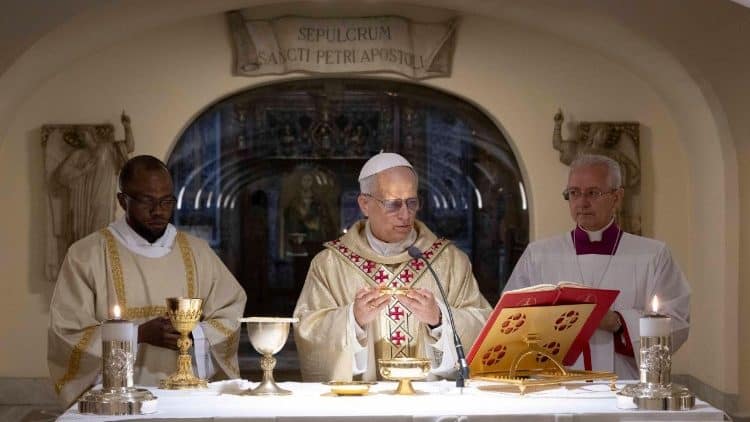
Mass Communication is a monthly post exploring liturgical signs and gestures as we experience them at liturgy. Today, I focus on the Communion Rite. Abbot Jeremy calls the Communion Rite the revelation of love. Love is completely defined. It is consumed in the Eucharistic Bread.
Before reflecting on the Rite itself, I acknowledge Joseph Ratzinger. I also acknowledge Raymond Moloney. They comment on the centrality of the Eucharist.
Joseph Ratzinger makes it clear that the Church is not a private sector. The Church “is not a club of friends or a leisure association that brings together men with the same likes and related interests” (Called to Communion 77). He teaches that the Church is public by her nature. The Church is the new people. This new people gather to be one thing.
The “Church is Eucharist” (Called to Communion 82), and “in both her proclamation of the Word, the Church constitutes a distinctive subject whose memory preserves the seemingly past word and action of Jesus as a present reality” (19). The Church is the kingdom of God revealed to serve the poor, the widow, and the marginalized.
Raymond Moloney, SJ emphasizes this point made by Ratzinger. Moloney says, “Christ, Church and Eucharist belong so intimately together that you cannot have one without the other” (The Eucharist Builds the Church 124). This Body of Christ assembles in a designated place each Sunday. It fulfills what God has intended for his people since the beginning. This action will cause the Church to be: to do Eucharist is to be Church” (Driscoll, What Happens at Mass 10).
This public gathering is a body of people. They do what they are called to be. The Church makes the Eucharist. The Eucharist makes the Church. Now to the Ritual.
Before the Breaking of the Bread, the community shares in the Lord’s Prayer. We utter the daily receiving of bread. It foreshadows not only our basic need for food. This is specifically ἐπιούσιον. The Greek translates to Tomorrow’s Bread. This daily bread foreshadows the one we are receiving in this humble unleavened loaf.
At the same time, we beg for forgiveness so that we receive the God worthily. This is articulated in the embolism that the priest offers alone. He prays that we be delivered from all evil. It is an expansion of the final petition in this prayer that Jesus taught us. Afterward, the community utters the doxology. Abbot Jeremy eloquently summarizes this moment as follows:
Our place of prayer is a middle ground: on the one hand, the evils of this world; on the other, the coming of Christ from the future. In this middle ground the whole assembly adds doxology to the priest’s expanded petition, a doxology which we can utter precisely because in hope we see our Savior coming (122).
We then move to a brief ritual exchange of peace which is not a “practical greeting” (Driscoll 123). We exchange peace which is a sign of our communion with each other.
The Bread is broken and prepared as gifts for the people of God. The assembly addresses Jesus as the Lamb of God. This images the moment in Revelation when we are all gathered around the slain Lamb.
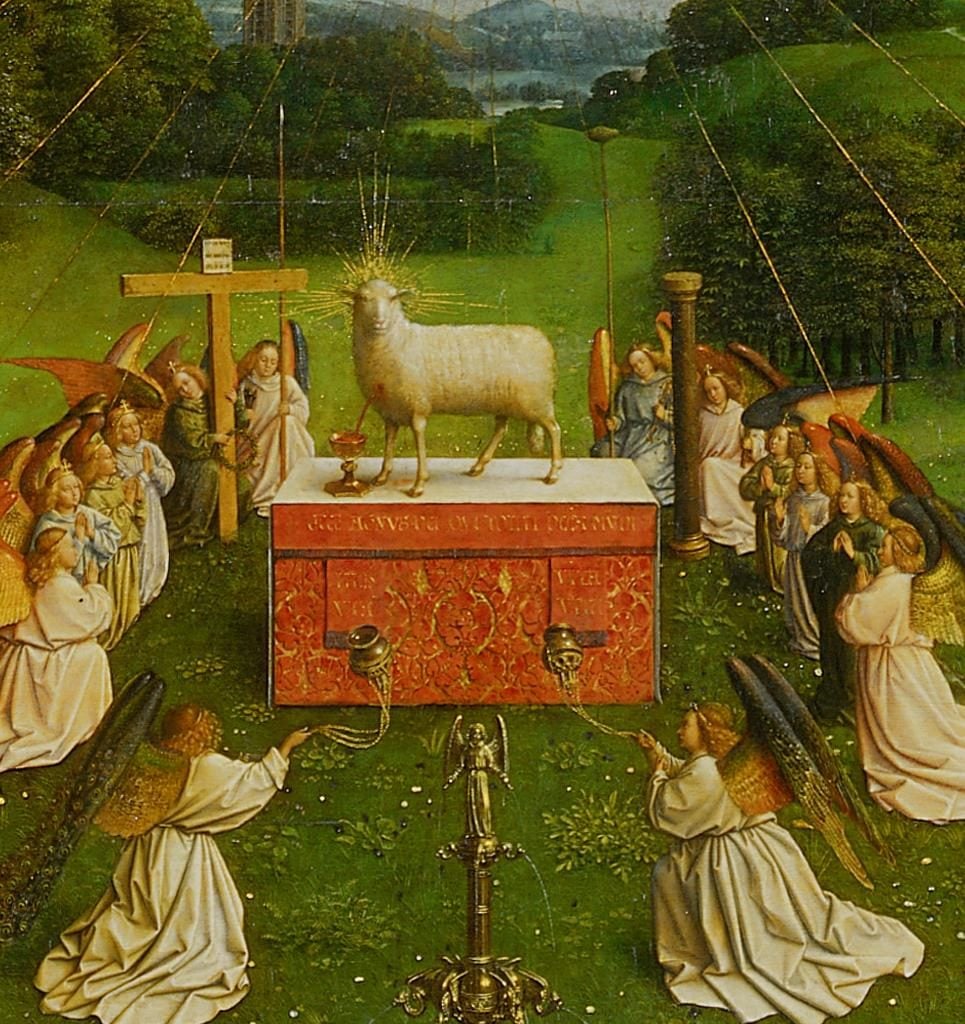
When the Communion Procession begins, we all sing! Through our singing voices we express how much we truly are grafted to each other in Christ. The General Instructions state:
While the priest is receiving the Sacrament, the Communion chant is begun. Its purpose is to express the communicants’ union in spirit by means of the unity of their voices, to show joy of heart, and to highlight more clearly the “communitarian” nature of the procession to receive Communion. The singing is continued for as long as the Sacrament is being administered to the faithful. (86)
After the final person has received Holy Communion, there is a time of silence. In this silence, we enter into private prayer together. The Church teaches:
When the distribution of Communion is finished, as circumstances suggest, the priest and faithful spend some time praying privately. (88).
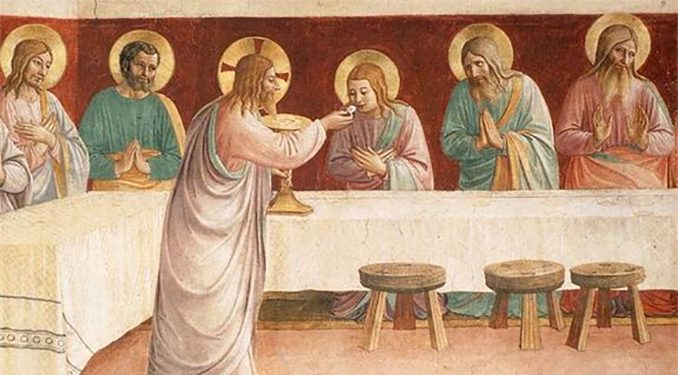
In this silent moment, we can find sentiments to offer Jesus in the silent prayer that the priest offers once he has received Holy Communion. He prays silently two options:
With faith in your love and mercy, I eat your body and drink your blood.
OR
By your holy body and blood free me from all my sins, and from every evil. Keep me faithful to your teaching, and never let me be departed from you.
To receive Holy Communion is to become what we eat. More precisely, we become who we eat. In his Confessions, Saint Augustine of Hippo records what the Lord tells him about receiving Holy Communion. God says, “You will not change me into yourself, as you change food into your flesh, but you will be changed into me” (7.10.16).
The priest utters a prayer that we bear fruit from this Eucharist and we all respond: Amen.
How moving that the God of the cosmos comes to us in this humble way! We swallowed all we have received in the Mass. How can we not kneel, sing, and be silent?
 Enlarge my heart
You are welcome to leave a reply.