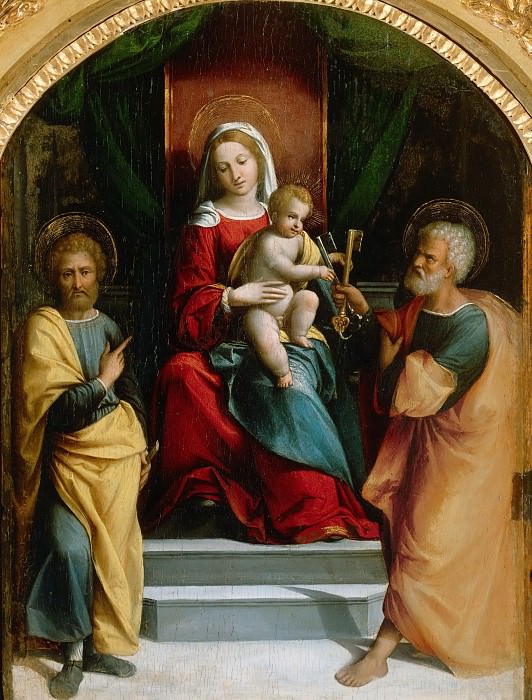
Gazes and gestures invite the viewer to deep conversation. Benvenuto Tisi, also known as Garofalo, most likely painted this small work for private devotion. Central to the image is the Virgin Mary in all her regal beauty, adorned with light. The lively Christ child plays with the keys which he will later give to Peter. His energetic pose is contrasting to Mary whose eyes look on him with love as she sits on the royal throne.
This is the perfect example of holy conversation, also known as Sacra Conversazione. High Renaissance art displayed devotionals with Mary and child as the central figure, gathered around them are the saints. They don’t seem to talk to each other because they are drawing us into communion with Mary and Jesus.
In this holy conversation, Jesus reminds us that while he is found everywhere he is also joyfully and fully somewhere. He is in his Church to which Peter is the chief custodian.
Paul stands with the symbol of his martyrdom. He is pointing to Christ. This is the summary of all his New Testament letters. It is not about him, it is about Christ, the central protagonist of human history.
These two men are celebrated today as patrons of Rome.
A longstanding hymn that is sung on the lips of all believers on June 29 speaks poetically of Peter and Paul’s influence on the Church. It is attributed by Elphis, the wife of Boethius. While Boethius is hailed in the Eastern Church as a saint and gave the world The Consolation of Philosophy, his wife gave us the poetry of these two illustrious saints that have stood the test of time!
What fairer light is this than time itself doth own, the golden day with beams more radiant brightening? The princes of God’s Church this feast day doth enthrone, to sinners heavenward bound their burden lightening.
One taught mankind its creed, one guards the heavenly gate, Founders of Rome, they bind the world in loyalty; One by the sword achieved, one by the cross his fate; with laurelled brows they hold eternal royalty.
Rejoice, O Rome, this day, thy walls they once did sign with princely blood, who now their glory share with thee. What city’s vesture glows with crimson deep as thine? What beauty else has earth that may compare with thee?
To God the three in one eternal homage be,
All honour, all renown, all songs victorious,
Who rules both heaven and earth by one divine decree to everlasting years in empire glorious.
The walls of Rome were signed with princely blood. We are called to share in this glory. Today’s feast day is a reminder that foundations are important! Who or what are the foundations that guide your Christian life? Who are what do your foundations point to in their gaze and gestures?
May Christ be the firm foundation of all believers! Happy Feast Day!

 Enlarge my heart
You are welcome to leave a reply.