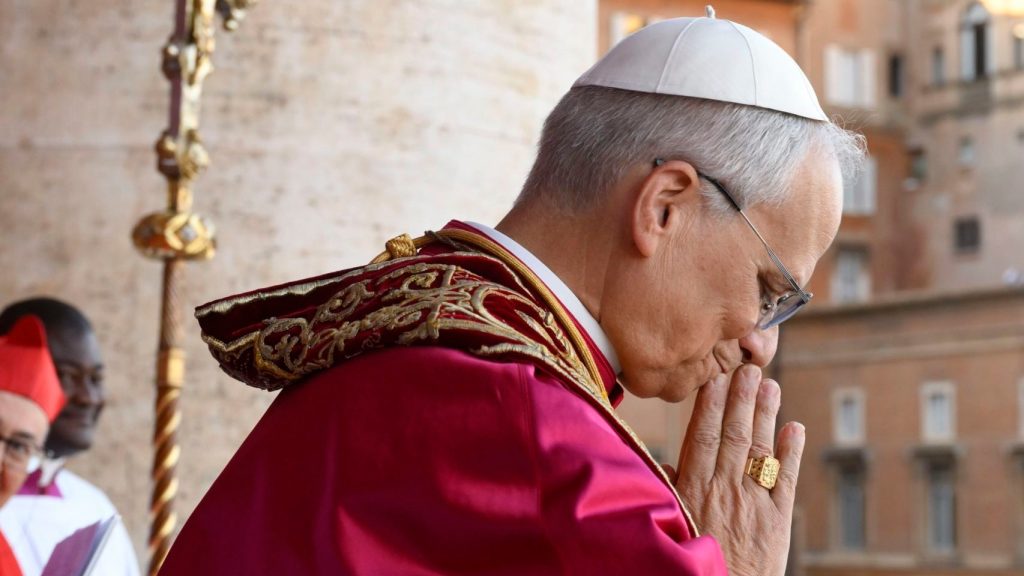
We are now in the age of Pope Leo XIV, the first successor of Peter born in the United States. I am sure this period in our history will be known as the Leo Effect. After years of serving the people in Peru and dicastery work in Rome, Pope Leo is a global man who now begins his ministry as Bishop of Rome and Succesor of Peter.
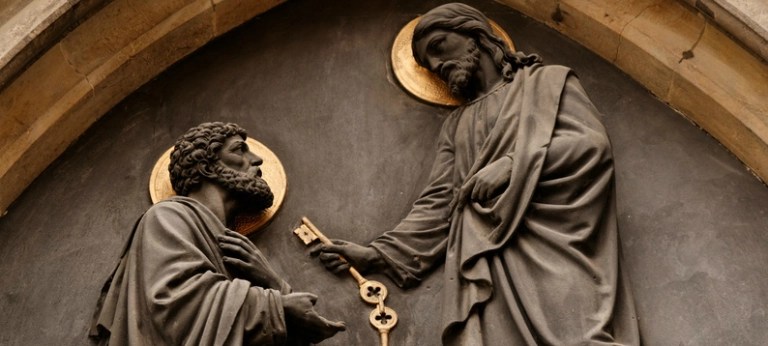
With the inauguration of his Petrine ministry this Sunday at 10am, I wanted to offer another insight to the one who holds the keys in Rome.
In 2021, my professor, Owen F. Cummings, released Popes, Councils, and Theology: From Pope Pius IX to Pope Francis. It is a delightful book that gives the profile of men exercising the petrine ministry along with councils and their important documents. It gives a balanced vision of history.
He makes the point that popes are not the history of the Church. Here’s a marvelous quote:
The Pope is not the church, and the history of the papacy is not the history of the church or the history of theology. Nevertheless, popes, church history, and theology necessarily come together in a Catholic understanding as each pope makes his own particular and distinctive contribution as the tradition moves forward (ix-x).
Over time, we will see the contribution of Pope Leo XIV on the global stage. As he officially begins his ministry, it is important to keep in mind a quote from Jesuit Karl Rahner regarding the papacy:
So, let’s allow each pope to have his own outlook. Let’s not expect that each pope will have the call and the ability to make each and every thing in the church better, especially when we aren’t exactly certain, in this or that particular question, whether progressivism or conservatism is the better course. And if the pope does not fulfll all the promise that I or anyone else expects of him, is that really so bad? That’s what happens in history and in a church that changes only very gradually over the course of history (95).
Cummings reminds me that there is no such thing as a Golden Age in the life of the Church where every theological issue was held in balance, no one was hungry, and liturgy was at its best. Rather, every generation believes that they live in the Golden Age only because the Holy Spirit remains with the Church.
As we witness this Inaguaration of the Petrine Ministry, I think of the image of Saint John Bosco’s dream.
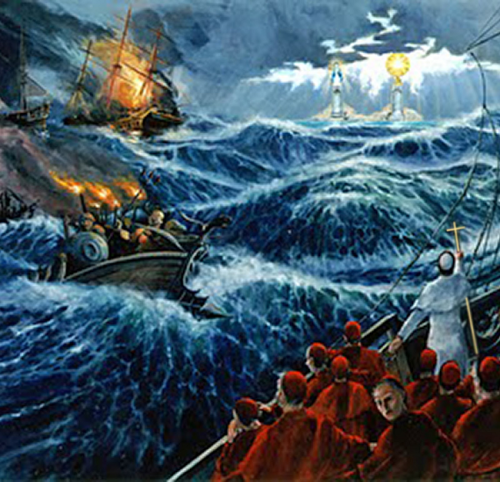
Bosco had a dream of the Pope, Eucharist, and Mary. The Pope guides the boat through the storm. The boat is an image of the Church. As long as he guides the Church toward two pillars, the Church will never sink. These two pillars are Eucharist and Mary. We must be anchored in Jesus and Mary and we will make it through the storm.
Here are three symbols worth noting at the Inaguration of the Petrine Ministry: Bones of Peter, the Pallium, and the Fisherman’s Ring.
Bones of Peter. The liturgy begins at the tomb of Peter. Pope Leo XIV will have a brief moment of prayer at the fisherman’s tomb accompanied by the Patriarchs of the Eastern Churches. We will see the connection of the past and present.
The Pallium. A scarf like wool material worn on the shoulders of a metropolitan archbishops and the pope. It has six woven crosses to symbolize the wounds of Christ. The wool scarf is an image of the Good Shepherd carrying his sheep on his shoulders. The pallium is a symbol of unity and fidelity to the pope and apostolic faith. On the feast on Saint Agnes, lambs are blessed by the pope and their wool is used to create the pallia. The pallium, a sign of unity among all bishops with the Bishop of Rome.
The Fisherman’s Ring. Just like a wedding, a ring is a symbol of permance and commitment. For a bishop, it is a sign of his fatherly care for the flock entrusted to his care. He is committed and wedded to his diocese until death. Symbol of his office, an office handed down through the generations.
A memory of the rock. When I was in Sydney in 2008, I met Pope Benedict XVI. It was my first time being with the people of God at World Youth Day. It was the first time I stood in the crowd and felt the immense energy of seeing the Bishop of Rome. As I cheered I could not hold back the tears. I heard someone yell to their friend right behind me, “Look! The Rock on which Christ promised to build the Church.” It was then that it all made sense.
What is the point? Christ is with his Church. Christ has kept his promise. He is with us to the end of the age. We do not have to look far to hear his voice and experiecne forgiveness. He has given us bishops to tend his flock.
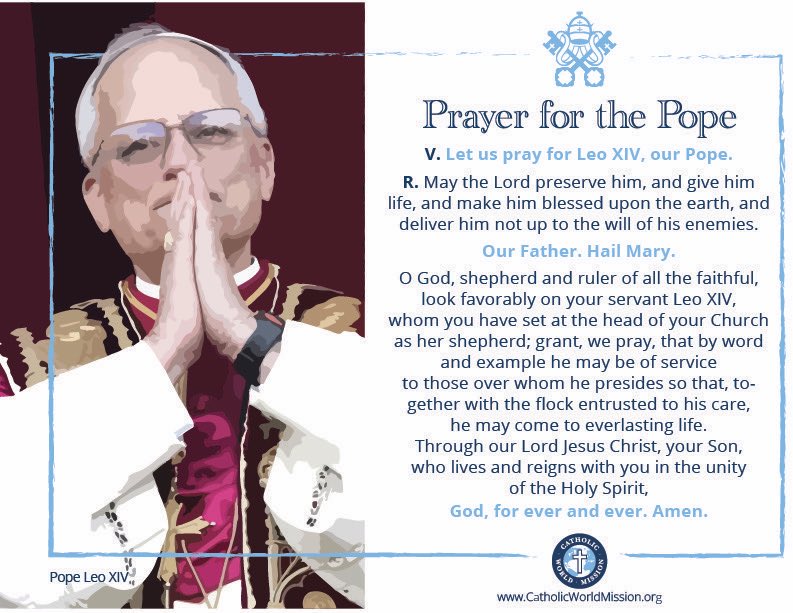
Update: Here are some quotes that struck my heart as I heard Pope Leo XIV deliver his homily at the Inauguration of the Petrine Ministry. To access the full homily, click here.
The authority of the Church is the charity of Christ! The Church is built on the love of the Crucified Christ, nothing else. Our service to others, in the name of Christ, comes from love. It does not come from power or exclusion.

We belong to the Church of Christ. It is always the Lord’s Church. Together, we are the Church and Christ is the head. We become part of his body through baptism. The Church is sustained by the Christ-like love that flows out from us toward others.
To be a united Church does not mean that we all need to be the same or that we need to conform. To be united is to value the history of every person and to walk together in harmony. The Holy Spirit is working through the hearts of all humanity.
The Church is called to be leaven, to be love, and to be the sign of unity for the world.


 Enlarge my heart
You are welcome to leave a reply.