
Above is a photo of our first morning in Galilee. My firstborn looks out on the sea at the break of morning.
Sunday is the last day of the Novemdiales: nine official days of mourning the death of Pope Francis, successor to Peter.
Sunday’s Gospel is timely as the Conclave begins this Wednesday. The Conclave will elect the Successor of Peter and John 21 is all about Peter and his desire to follow the Master. The Gospel should be familiar to our liturgical ears. We heard a part of this passage during the Easter Octave. I write about the first part of this account here.
In this post I want to focus on the life of Peter and then reflect on its relevance on our lives. Peter was called, witnessed conversion, and made his confession that revolutionized the world.
Peter was called. In Galilee, as Peter was going about his daily life, he meets the Rabbi who was the skilled carpenter. Here is Matthew’s account:
As he was walking by the Sea of Galilee, he saw two brothers, Simon who is called Peter, and his brother Andrew, casting a net into the sea; they were fishermen. He said to them, ‘Come after me and I will make you fishers of men’ (Matthew 4:18-19).
Luke’s account is slightly different. The Rabbi gives him instructions to cast his net onto the other side. The skilled fisherman trusted the word of the master carpenter and teacher. After the miraculous catch, Peter is filled with amazement and fear asking the Master to depart from him. Yet, Jesus gently calls him to follow.
Even today, the Lord calls us. In one perspective, he call us with determination underlying the weight of his command. At the same time, he calls us with immense love. Knowing everything about us, he summons us into communion with him. He calls us to journey with him.
Peter witnessed conversion. His home was the place of operation. Throughout the three years in Galilee, Peter witnessed countless miracles of Jesus. Peter witnesses the feeding of 5,000 Jews (Matthew 14:13-21) and the feeding of 4,000 Gentiles (Matthew 15:32-39). He sees Jesus feeding everyone! Many miracles and hungers satisfied through the Master.
Peter witness Jesus walk on water. Jesus invites Peter to do the same (Matthew 14:22-33). Peter focuses on the Lord’s gaze. As the Lord calls his name, perhaps Peter remembers the Lord’s first invitation to follow him on the shores of Galilee. Peter is distracted by the wind, looses sight of Christ and begins to sink.
The Lord is merciful as he rescues Peter immediately. The Lord does not stop the storm! He saves Peter in the midst of the storm.
Call and witness moves us to Peter confession in his faith in the Lord. His love for Jesus is strengthened in his Confession (Matthew 16:13-20). The location where this confession takes place is worth noting: Caesarea Philippi.
Caesarea Philippi is 25 miles north of Galilee at the base of Mount Hermon. It has one of the largest springs that feed the Jordan River. The God Pan was worshipped there. Half goat and half man, depicted for playing the flute.
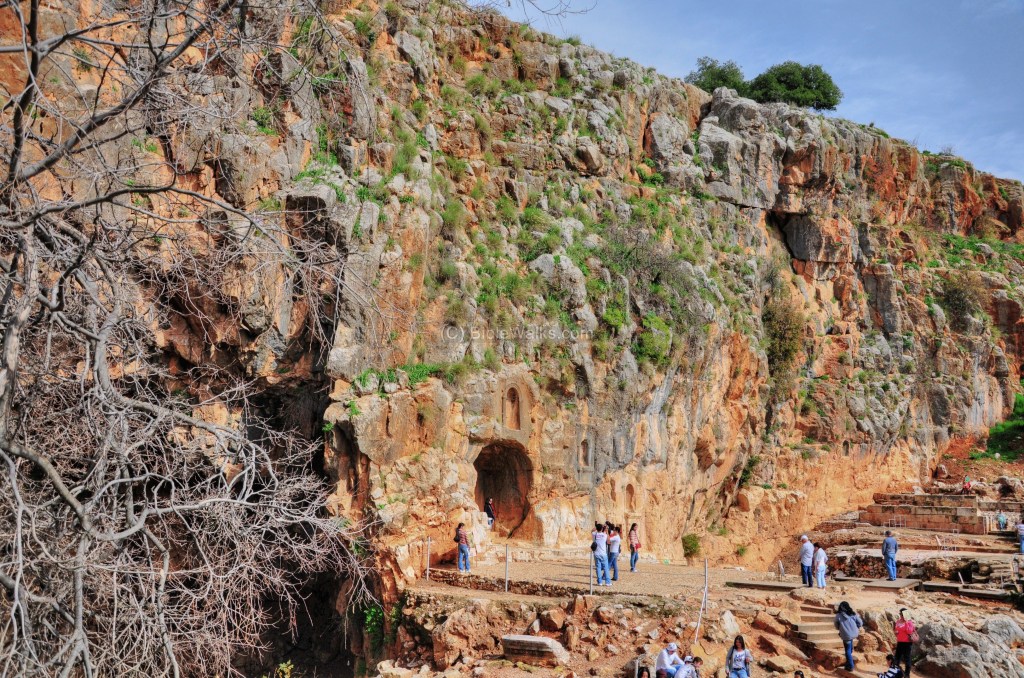
Pan evoked fear, hence the word panic. In Caesarea Philippi, Pan was the guardian to the gates of the underworld. In this same place, Jesus tells Peter that he will be the rock and that the gates of hell will never prevail against the Church. Peter will be the primary custodian of the Lord’s Church. Jesus is always the head of his Church, not Peter. Starting from Peter’s confession, Jesus begins the journey to Jerusalem. Peter will follow.
On the journey toward Jerusalem, Peter witnesses the Lord’s Transfiguration (Matthew 17:1-7) to once again strengthen his love. I have reflected on this mountain top experience in a previous post here.
Through the life of Peter, we feel this sense of call, witness, and conversion. We have insight into this Galilean experience of walking with Jesus.
Peter made many mistakes, failed to walk on water, denied Jesus even as Jesus looked to him in his passion. Yet, Peter repented. Peter was rooted in Jesus who was forming his love.
At the first Eucharist, we see the Primacy of Peter who is to “be the custodian of communion with Christ for all time. He must guide people to communion with Christ; he must ensure that the net does not break, and consequently that universal communion endures. Only together can we be with Christ, who is Lord of all” (Pope Benedict XVI, General Audience, June 7, 2006).
In the same manner, the Lord will not take away our fears. Jesus will not necessarily calm our inner storms, but with eyes focused on him, he remains with us in every season. Jesus awaits our confession, our recognition of him as Lord over our lives. Jesus is patient with us.
This brings us to the conversation today. After the Resurrection, Peter and the disciples returned to Galilee. They return to their lives as it was before they met Jesus. Then Jesus appears to them at a distance, invites them to cast their nets on the other side. The Beloved recognizes the Lord and Peter runs to him!
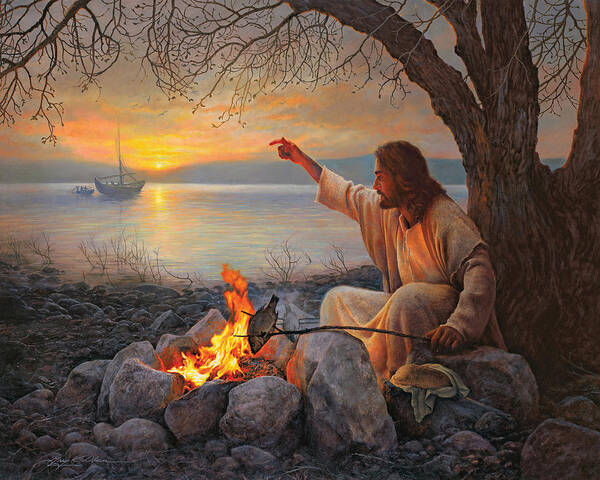
Here is a poem that speaks of the moment. It is When Fish Multiply. Written by Rita A. Simmonds.

You stood on the shore.
I didn’t recognize you at first because you seemed too real for someone already gone, but something about the scene reminded me of you:
The long night at sea, moving farther and farther into the deep, eyes heavy, wanting to close, dreaming of you dreaming in the boat, or walking towards us on the waves, urging us to not be afraid, and this strange man commanding us to lower our nets, to work in a different way to make our catch.
We listened and obeyed but didn’t expect what memory proves:
When fish multiply, the reason is you.
Fish and bread, a remembrance of the Master feeding the thousands and a reminder of the command, “Do this in memory of me.”
Jesus had breakfast with them and asked Peter the timeless question: Do you love me?
In Greek, the conversation is fascinating. The English word for love is love. There is no distinctions in the different grades of love. In Greek there are many words for love. We will focus on two. Greek has fileo which means the love of friendship. It is a love that is tender but not all-encompassing. There is also the word agapao which means love without reserve, total and unconditional.
In this threefold conversation, Jesus initially asks Peter if he loved him without reserve. Peter responds telling the Lord that he loves him with his poor human love, with his fileo. A second time, the Master of his heart asks him if he loved him totally and unconditionally. Peter responds “Kyrie, filo-se” which translates to something like “I love you as I am able to love you.” Finally, the gentle Lord asks, “Fileis-me?” to which Peter responds: “Lord, you know everything; you know that I love you (filo-se).” This divine conformity gave Peter the restoration needed to trust the Master and follow him.
Saint Pope John Paul II speaks of this restoration when he said, “The warmth of Jesus’ friendship has overcome the Apostles’ fears. The weight of guilt and sadness has given way to the light and peace of the Risen Lord.” In this threefold conversation of love, Jesus commands Peter to feed his sheep. Therefore, Eucharist and serving the poor are matters of love. Once again, the Lord is preparing Peter’s heart. Ultimately, the philo of Peter’s love will be transposed to agape, as he gives his life without reserve for his master and friend.
In the days ahead, we will witness the Cardinals enter Conclave to elect one who will exercise the continuity of the Petrine Ministry. We pray for them that the Holy Spirit guide them to elect one who will illuminate the heart of Jesus and will strengthen the bonds of communion.
As we reflect on the life of Peter of Galilee, we must reflect on our Galilee. Our Galilee is in all of us. It is the place where we first met Jesus. Jesus stayed with us in our storms, fed us until we were satisfied, and like Peter, prepares our hearts to love him without reserve.
Pope Francis gives us a gentle reminder of what our Galilee truly is. It is the primitive encounter with Jesus:
In the life of every Christian, after baptism there is also another “Galilee”, a more existential “Galilee”: the experience of a personal encounter with Jesus Christ who called me to follow him and to share in his mission. In this sense, returning to Galilee means treasuring in my heart the living memory of that call, when Jesus passed my way, gazed at me with mercy and asked me to follow him. To return there means reviving the memory of that moment when his eyes met mine, the moment when he made me realize that he loved me.” – Easter Vigil Homily: 2014
 Enlarge my heart
You are welcome to leave a reply.