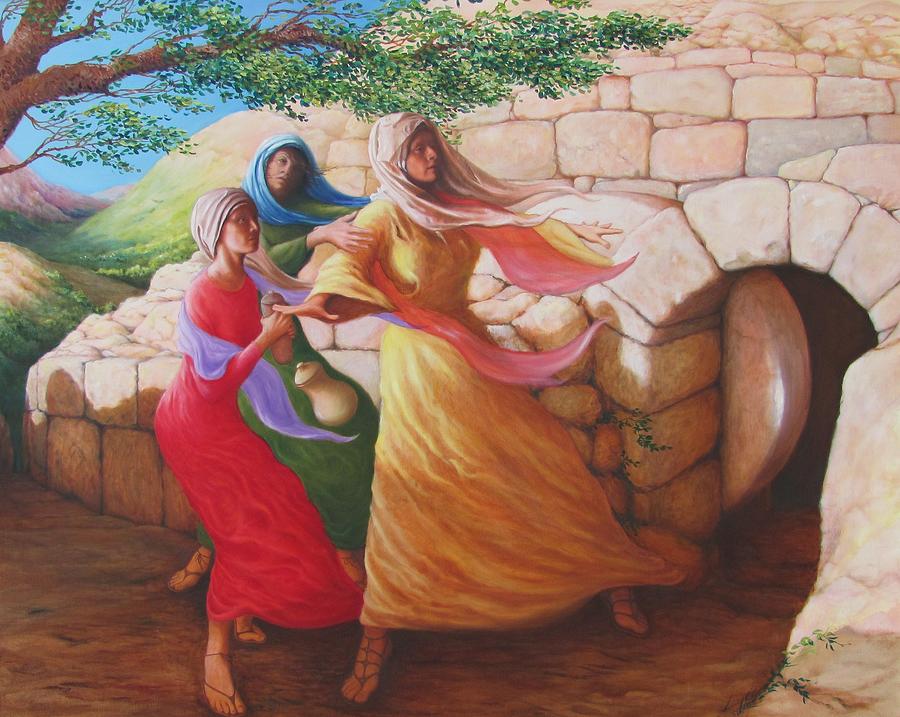
Today, we hear Mark’s account of the Resurrection. At this point we have felt the weight of many accounts of our Lord’s Resurrection. They vary in persons, time, and evoke different emotions. Such variety speaks of the immensity of this new way of life.
Abbot Jeremy gives insight to the Resurrection accounts:
It is not possible to coordinate the resurrection accounts of the four evangelists. They are not consistent in their details. They create different moods. They evoke different reactions. They raise and answer theological questions differently and leave other questions unanswered. At first glance this may seem disturbing, even cause for doubt. But actually the fact that such a coordination is impossible is rooted in the new reality itself of resurrection. The texts refuse to let themselves be tamed into a simple narrative of just another something that happened and can be told. We are in a new realm now where language and narration struggle, and the different narrative styles and details of the evangelists are Spirit-inspired means that put us into contact with this new reality, this new realm of inexhaustible richness, a reality (98).
The text refuses to be tamed! With this in mind we consider Mark’s account of the Resurrection.
Mark gives a very brief account in his final chapter. The brevity gives this sense of urgency to announce the Gospel to the world. A careful reading will point out that at the Easter Vigil we only hear Mark 16:1-7 in Year B. We are left pondering the amazement of the women. Mark emphasizes three truths: Jesus has been raised; he is not in the tomb; and this empty tomb should be carefully observed with wonderment. The final verse of this Gospel is left out! It states,
And they went out and fled from the tomb; for trembling and astonishment had come upon them; and they said nothing to anyone, for they were afraid (16:8).
As mentioned, this detail is left out at the Easter Vigil, so that we can hold on to the wonderment of the women. At the same time, we are left to draw our own conclusions for our lives.
Either the Lord Jesus did not rise from the dead and the story ends there … I am left with a dead savior or he is truly risen, the tomb is empty, and I am his witness.
On the Saturday of the Octave of Easter, we hear Mark 16:9-15 which is an alternative ending to Mark’s account. The Lord appears to Mary Magdalene, two disciples, and commissions the Eleven to preach the Gospel. He then ascends to his Father’s glory.
Again different perspectives of the same account as the new life of the Resurrection refuses to be tamed by the text.
In reflecting on the Resurrection today, we turn to a well-known Easter hymn during these eight days.
From Easter Sunday throughout the Octave of Easter, the Church sings Victimae paschali laudes, the hymn celebrating the Resurrection of Christ. Composers like Palestrina, have offered beautiful settings to the text. Below is Palestrina’s rendition of the text with English subtitles.
Here is an English translation:
Christians, to the Paschal Victim
Offer your thankful praises!
A Lamb the sheep redeems;
Christ, who only is sinless,
Reconciles sinners to the Father.
Death and life have contended in that combat stupendous:
The Prince of life, who died, reigns immortal.
Speak, Mary, declaring
What you saw, wayfaring.
“The tomb of Christ, who is living,
The glory of Jesus’ resurrection;
bright angels attesting,
The shroud and napkin resting.
Yes, Christ my hope is arisen;
to Galilee he goes before you.”
Christ indeed from death is risen, our new life obtaining.
Have mercy, victor King, ever reigning!
Amen. Alleluia.
If Christ had not risen from the dead, our faith would be in vain. In this octave, let us rejoice that Christ has trampled death. Death is now the doorway we all past to fall into the arms of our loving God.
 Enlarge my heart
You are welcome to leave a reply.