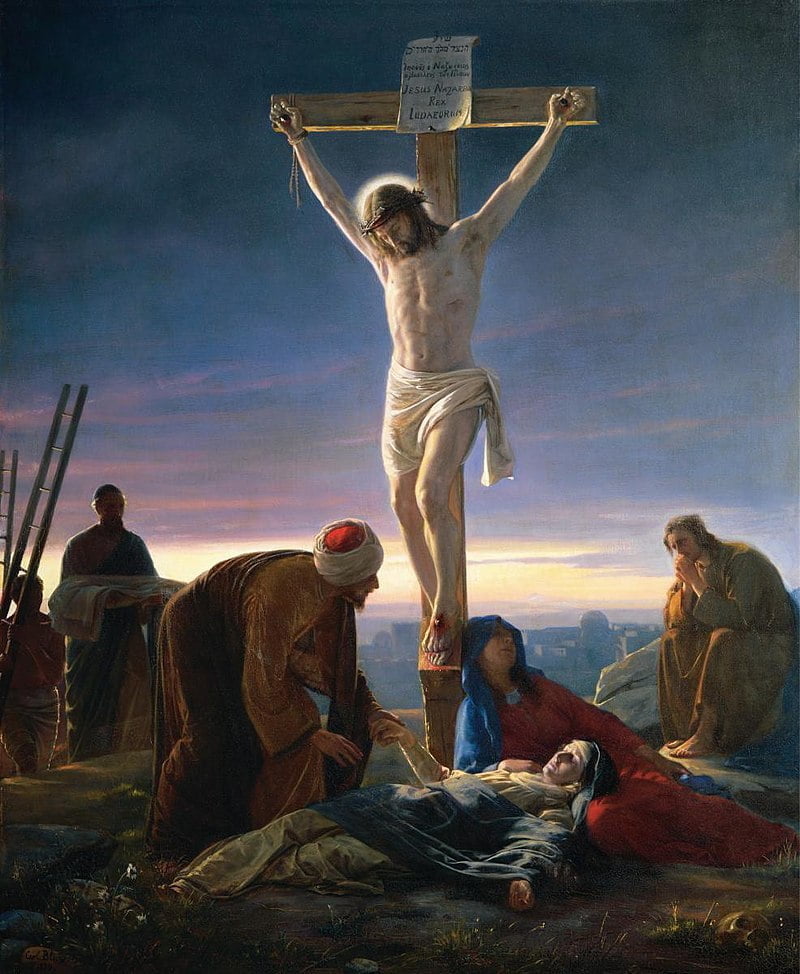
What is so good about Good Friday?
There is a particular ritual on Good Friday. We adore the Cross of Christ. This ritual is traced to the fourth century church of Jerusalem. After the solemn entrance of the Cross, the priest removes his shoes. The Roman Missal says:
For the Adoration of the Cross, first the Priest Celebrant alone approaches, with the chasuble and his shoes removed, if appropriate.
This gesture is a reference to a passage in Exodus 3:5:
God said: Do not come near! Remove your sandals from your feet, for the place where you stand is holy ground.
The feet that our Lord washed on Holy Thursday is now bare before his Cross. We are naked before God symbolized in the removing of the priest’s chasuble. We behold the love of God, fully displayed in the suffering of Christ. Pope Francis speaks of this love stating:
The cross is Jesus’ most eloquent word of love. A word that is not shallow, sentimental or merely edifying. It is love, sheer love (46).
With our bare feet, we meditate. Let’s observe a piece of music used during this sacred moment.
The Reproaches is a text that can be sung during the Veneration of the Cross. It can be controversial and viewed as anti-Semtic.
One must understand its text in a Christian key. When the text sings of Israel, it speaks not only to the Jews. It is also to all Christians and the whole Church. The Christian Church understands her relationship to Israel. We are grafted into Israel’s history. The text is addressed to me, a sinner.
Here is a setting to the text by the British composer John Sanders (1933–2003). Sanders first wrote it in 1984 for a Good Friday service at Gloucester Cathedral. He served this cathedral as organist. Sanders scored his for eight voices, offering the listener more complex harmonies, including dissonance. The dissonance allows us to feel the suffering of Jesus on his cross.
Abbot Jeremy comments on the Reproaches in his book, Awesome Glory:
The Reproaches are called such because they are poetic texts in the prophetic style (see Micah 6:3) that give voice to what the dying of Jesus would “say” to us. They are haunting, sad melodies in which Jesus asks, “My people, my people, what have I done to you? How have I offended you? Answer me!” The verses are developed by recalling major scenes from Israel’s salvation history, and then contrasting these with Jesus on the cross … These are heartbreaking meditations, for they help us to realize how absolutely horrifying are our sins which have led to Jesus’ death, how deep our betrayal (72).

We are all responsible for the death of the Son of Man and we all beg for his mercy:
O holy God!
      O holy God!
   O holy strong One!
      O holy strong One!
   O holy and immortal, have mercy upon us.
      O holy and immortal, have mercy upon us.
We beat our chest as we behold the Lamb of God on his Cross. The reference to the Holy thrice comes from the prophet Isaiah (6:1-4). The expression “Holy is God! Holy and Mighty! Holy and Immortal One” was sung in Greek in the Jerusalem liturgy. This practice is often maintained in the Greek language today. It shows how ancient this text is to our liturgical experience.
Abbot Jeremy comments on how the Reproaches may not be a fitting title to the text. He says:
It is not in fact Jesus who is reproaching, as he dies. The words placed in his mouth in these texts are a poetic form by which in some sense we reproach ourselves by imagining what Jesus, so unjustly treated, could have said but, strikingly, did not.
I return to the question at the beginning of this post. What is so good about Good Friday? Bare feet, no shoes. Love on full display through wood, poetry, and liturgy. Behold! Love is fully disclosed to the world.
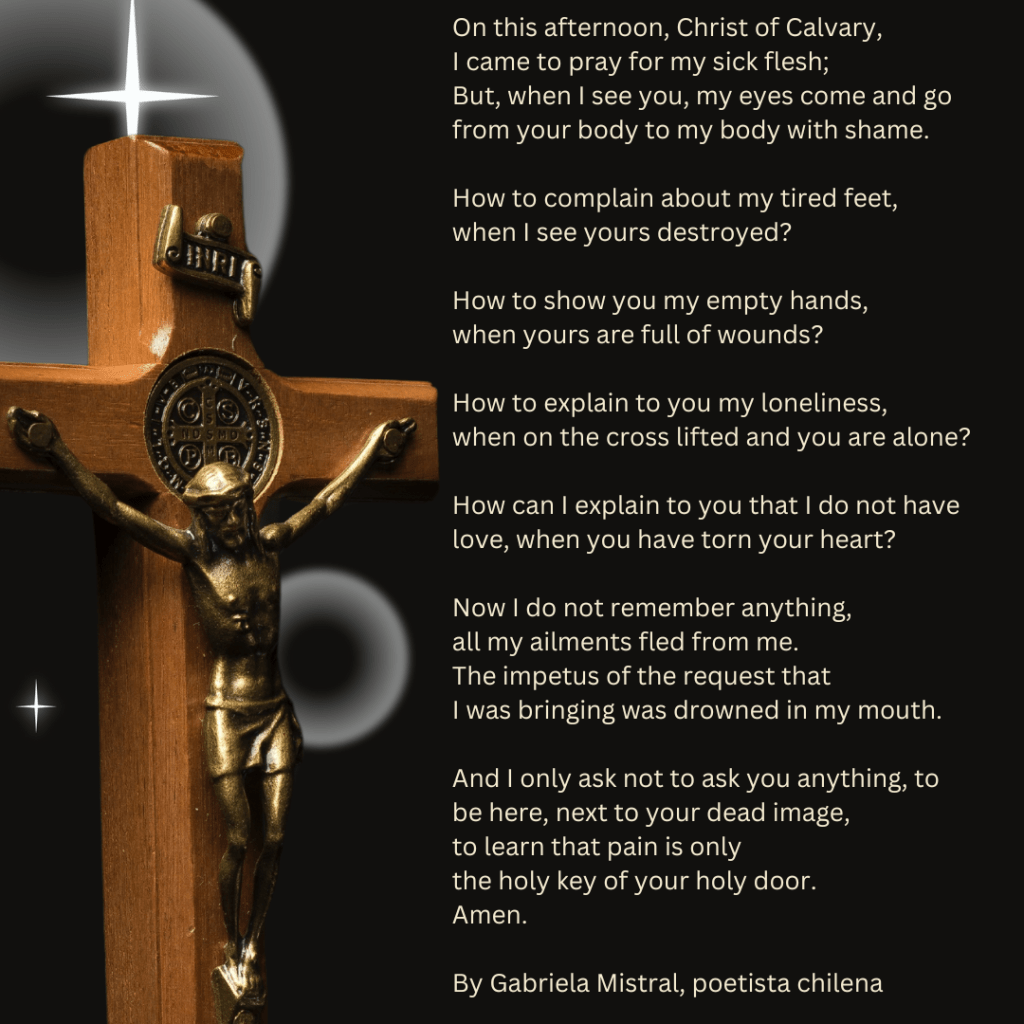
Each Good Friday, I read this poem by Chilean poet Gabriela Mistral. His suffering become the key to that holy door we must all open one day.


 Enlarge my heart
You are welcome to leave a reply.