
We are in the middle of a Jubilee Year! The theme of this Jubilee is Pilgrims of Hope.
I am digging around the theological ideas of hope with Pope Benedict XXI as my guide. The pontiff wrote Spe Salvi in 2007. It is a global letter on hope. Today’s post explores the question: Is Christian hope individualistic?
We can get lost in the clutter of life and think that my hope in Christ is enough. It is Jesus and me. We can easily forget others in our walk with Jesus.
Pope Benedict XVI widens our lens of faith on this matter. He points out that “salvation has been considered a social reality” (14). Hope is built upon a city which is address in the Letter to the Hebrews. It is God who builds this city.
for he was looking forward to the city with foundations, whose architect and maker is God … God is not ashamed to be called their God, for he has prepared a city for them (11:10,16).
Hope unites us and builds a heavenly city. Sin does the opposite. Sin disunites us. What Christ won on the Cross was redemption that re-established this unity.
The sacramental life gives us clear vision to this idea. When we are baptized, it is the community that gathers. When we celebrate Eucharist, the baptized and ordained priesthood praise God collectively. When we look at the Sacrament of Reconciliation we are restored to Christ as a disciple AND we are restored to the faith community.
Augustine spoke about charity being the primary principle in building this city. It is the mortar that hold the heavenly bricks of this spiritual city together. This is modeled in monasteries throughout the Christian tradition. Monasteries became spiritual centers. People who left the world to make holy the ground where they were. Stability moved them to till and grow fruits of the earth. Stability allowed them to sing the praises of God in one place so that the spiritual roots go deep into the soil.
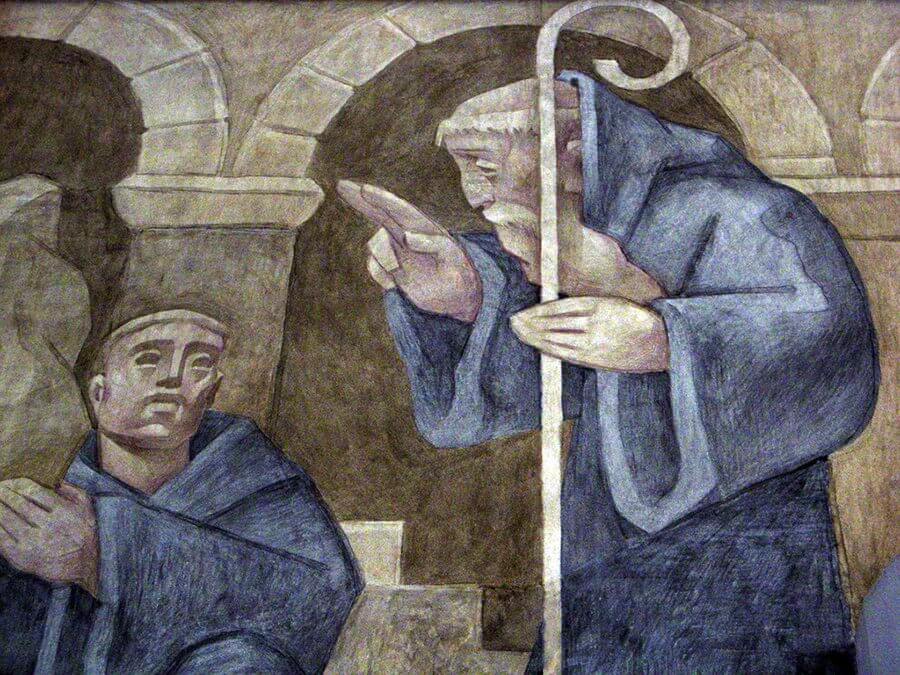
Furthermore, monastics are a reminder that we are made in the image of God. Monastics remind us to be co-creator with God and take down the spiritual trees of pride, cut down the overgrown weeds where spiritual predators lurk. As man cares for the earth, he is also caring for the conversion of his body and soul. This is the heart of stability in which monasteries are a symbol of hope in the world.
How is this applicable to us today? We can be pilgrims of communal hope in this specific Jubilee Year by looking to our neighbor.
Pope Francis calls us to be tangible signs of hope during this Jubilee Year.
The pope calls us to be hope for prisoners.
Francis felt strongly about being hope for prisoners that he spoke of his desire to open a Holy Door in a prison. He wants those confined to prison to remember their dignity and to have the opportunity to be reintegrated into society and have respect for the law.
The Bishop of Rome calls us to be hope for sick.
Francis reminds us that we are part of one chorus in caring for the sick. We need the professional assistance from nurses and doctors. At the same time, the sick need the compassion and love of people in their family and the community.
The Vicar of Christ calls us to be hope for the young.
Our future depends on the enthusiasm of the young. In one sense, it is amazing to see them participate in service. Yet, there are many youth who are also discouraged because of unemployment. As a Church, it is important for us to journey with the youth, allow them to ask their questions, and accompany them as they journey in faith.
The Successor of Peter calls us to be hope for migrants. Francis calls us to have a spirit of welcome:
A spirit of welcome, which embraces everyone with respect for his or her dignity, should be accompanied by a sense of responsibility, lest anyone be denied the right to a dignified existence. Exiles, displaced persons and refugees, whom international tensions force to emigrate in order to avoid war, violence and discrimination, ought to be guaranteed security and access to employment and education, the means they need to find their place in a new social context (13).
Christians have a responsibility to defend the migrants lest everyone is robbed of a better future.
Francis calls us to be hope for the elderly.
Christians are responsible to strengthen the bonds of generations. In a particular way, we should share hope with our grandparents who helped pass down customs, culture, and family values. We appreciate them for the wisdom they share with us.
This Lent there are many opportunities to be hope for others. We are a hope-filled people together! At the center of our hope is Christ the Lord.
 Enlarge my heart
You are welcome to leave a reply.