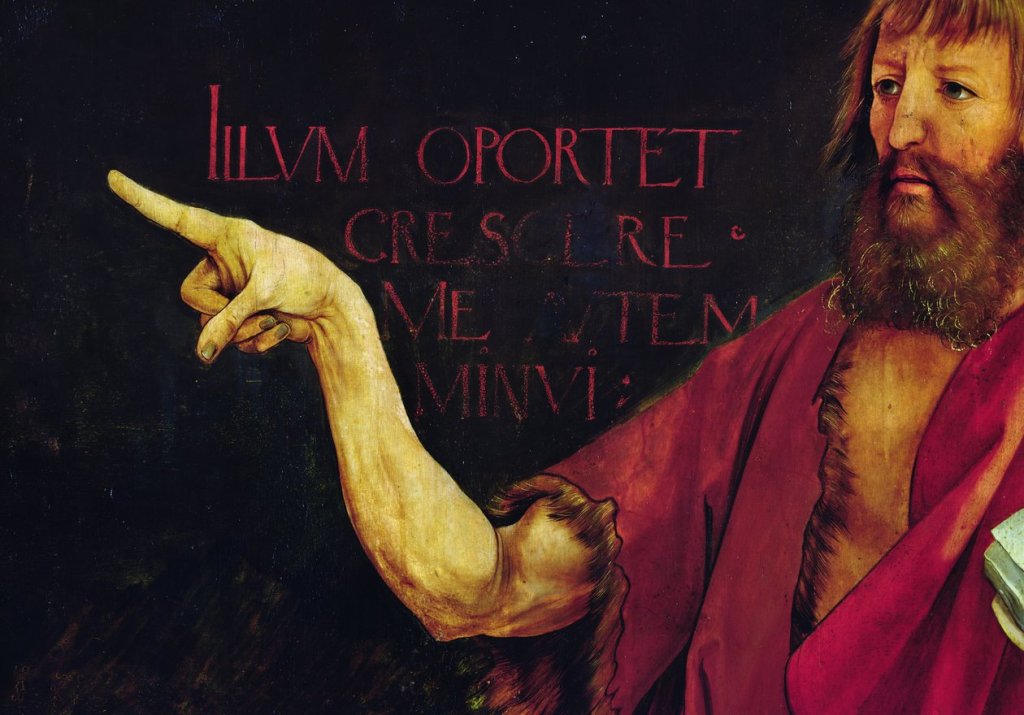
John the Baptist proclaims the famous Advent call: Prepare the way of the Lord! How does this timeless message resonate with us?
Luke centers John’s exhortation in a historical framework. He gives us the context in which John the Baptist appears on the scene:
In the fifteenth year of the reign of Tiberius Caesar, when Pontius Pilate was governor of Judea, and Herod was tetrarch of Galilee,
and his brother Philip tetrarch of the region
of Ituraea and Trachonitis, and Lysanias was tetrarch of Abilene, during the high priesthood of Annas and Caiaphas, the word of God came to John the son of Zechariah in the desert.
The great figures of history serve as the framework for the lowly who are about to welcome their savior!
The parents of the Baptist, Zechariah and Elizabeth, come from the priestly line. Thus, John becomes the last priest of the Old Covenant. Dr. Owen F. Cummings has this to say about the parents of the Baptist:
“Zechariah and his wife were not just doing what they were told by God, obeying the Torah rules and regulations, they were expressing their love for God through their Torah observance as best they could. They were lovers of God as God was lover of them” (Visiting the Visitation, 54).
From this priestly line, the Baptist prepares the way for the new worship in Jesus. In the video below, we can imagine the baritone voice of the Baptist singing this in the desert.
John is the voice crying in the wilderness! John plays a crucial role and does it always in the framework of the coming of Jesus. Saint Augustine said:
“John is the voice, but the Lord is the Word who was in the beginning (cf. Jn 1:1). John is the voice that lasts for a time; from the beginning Christ is the Word who lives for ever. Take away the word, the meaning, and what is the voice? Where there is no understanding, there is only a meaningless sound. The voice without the word strikes the ear but does not build up the heart.”
John was not only the voice of the Word, he was one who deeply loved God. John gave his whole life to God as a testimony. Jesuit scholar, Jean Danielou, has this to offer:
And at the end of it all John gave Love’s supreme testimony; he was imprisoned and then killed because he went on giving witness to the truth to the very end. He was imprisoned, beheaded, abandoned, forgotten; he had given up everything down to life itself” (Jean Danielou, SJ, Advent, 78).
I want to point out one more detail about the Baptist. I invite you to contemplate the great altar masterpiece of Matthias Grünewald (1480-1528). It is known as Isenheim altar piece. It is pictured below.

This is a captivating image of the John the Baptist. He is pointing to the Crucified One. Dr. Cummings offers insight to this masterpiece:
We too are that pointing finger, pointing to Jesus, the final fullness of God’s presence. However, we are not simply pointing to Jesus as to the “coming one.” We are pointing as Jesus’s holy body, the body of Christ as we say. It’s not just as fingers but through the totality of our lives that we signal to others this fullness of Christ’s presence. We are the pointing finger of John the Baptist, yes, but we are so much more, we are the living body of Christ the Lord” (Visiting the Visitation, 62).
We are called to be like John. Be the voice of the Word that is coming. Be the one pointing to Christ. As we gather for our holiday parties, let your kindness allow people to rethink and consider God. Let your hospitality move hearts so that others are hospitable to welcoming Jesus as he comes to them.
And above all, carve out time for deliberate reflection. Let’s sit before our manger scenes, in front of the fire place or wherever home is for us. Be still. Wait for his coming. This is the most basic way we can prepare for the Lord.

 Enlarge my heart
You are welcome to leave a reply.