Let’s take stock of where we have been these past few weeks as we reflect on John 6.
The Church opened a few weeks ago with John 6, as Jesus fed the thousands. Philip trusts Jesus in his practical response to not having enough food. The following week, I asked where we get our food: from the fleshpots of our slave masters or from the one who gave manna and quail in the desert. God teaches us to depend on him in the desert. He prepares a way for us to receive proper food. I then explored what it means to imitate Christ. We imitate others by loving what they love and how they love. We must spend time with the people we love and eat with them. These are two essential things of life; they are how we taste and see God’s goodness. Finally, last week, I delved into the concept that we find immense strength within the Body of Christ as we sing psalms to each other. It’s the Holy Spirit that forms, informs, and transforms us within the community into the Body of Christ, a beacon of hope fully alive for the world, supporting and empowering each of us.
We reach the final Sunday of this Eucharistic exploration of the life of the Church. Throughout our lives, we will be restless and hungry. We fill this restlessness with our phones and distractions. We fill our hunger with lust, pride, and ego. We will always be restless; we will continuously want more to eat. I think of a quote from Karl Rahner, “In the torment of the insufficiency of everything attainable we come to understand that here, in this life, all symphonies remain unfinished.” We cannot allow our restlessness to be a cancer in our lives. We must abandon our restlessness and hunger to the heart of Jesus, who fills all this with his presence, bringing us comfort and peace.
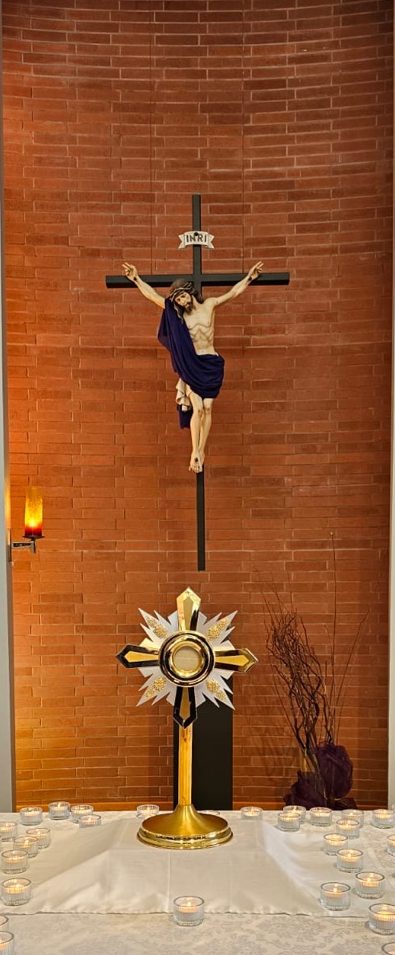
I take us back to the beginning. Philip, a practical man who desired to follow Christ, knew limitations. He was restless and wanted to be sure everyone had food. He questioned how to feed the five thousand when he said, “Two hundred days’ wages worth of food would not be enough for each of them to have little.” Did Philip feel impotent at this moment? He now hit a brick wall and could not break through as he sought to give his all to the Lord. When Philip placed his restlessness before God, Jesus satisfied his aching heart. It is ok to be restless. It is ok to be hungry. We find the completeness of life’s symphony in Jesus.
In today’s Gospel, we hear the one question we must all answer: “Do you also want to leave?” Jesus asked this question after many of his disciples returned to their former ways of life, unable to accept that Jesus is the Bread of Life. Saint Paul reminds us that Jesus invites us into this holy union with him. As Christ lays down his life for the Church, so too, every husband lays down his life for his bride. In this union found in the Eucharist, there is a total free, life-giving gift that Jesus desires to give to our restless hearts. We can abandon our incompleteness in him, who gives our lives new meaning.
John’s account of the Eucharist is different from the Synoptic Gospels. Matthew, Mark, and Luke recall the Last Supper and in John’s account, Jesus washes feet and gives this beautiful exposition of John 6. With this in mind, we keep in mind that John wrote this account “that you may believe that Jesus is the Christ, the Son of God, and that believing you may have life in his name” (John 20:31). Jesus satisfied the thirst of the woman of the well (John 4), gave sight to the blind man (John 9), and raised Lazarus from the dead so that we may believe (John 11:38-44). Jesus teaches us about the Bread of Life, so that we may believe. May our belief move us to taste and see how good God is.
 Enlarge my heart
You are welcome to leave a reply.