I heard a simple message during one of the talks in Indianapolis for the Eucharistic Congress: “Stop living for God. Live from Him!” This quote is a call to live a Eucharistic-centered life. To live for God implies fighting for a slogan or ethical idea. To live from God orients us to our source. The Eucharist nourishes us; from that point of departure, we live out our discipleship. The Eucharist makes the Church. The Church makes the Eucharist.
At the core of our existence, we all ask the same question: ‘Where will I find sustenance?’ The answer is stark: either we nourish ourselves with the Eucharist, grafting onto God’s life, or we consume poison. The Eucharist, a gift from God, provides all we need. As the psalm echoes, ‘The hand of the Lord feeds us. He answers all our needs … You open your hand and satisfy the desire of every living thing.’
Living from God and feeding from God is not always easy. To achieve this, we must remain in communion with each other. Paul reminds us that the core of our unity is baptism. In one faith and one baptism, we can bear with one another through love. We build unity, and in this unity, we find our strength and purpose.
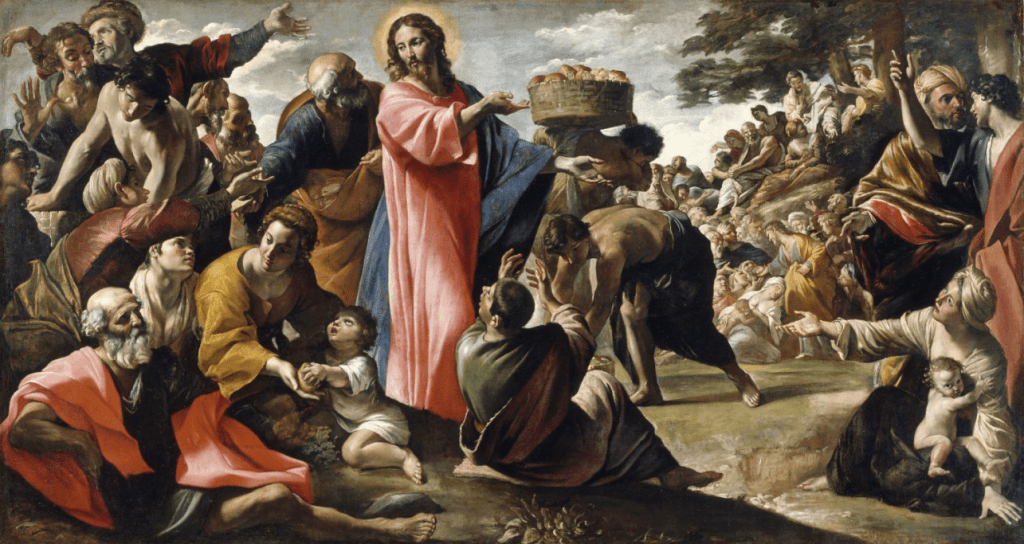
This Sunday’s Gospel tells of how Jesus fed the thousands in abundance. In this account, we meet Philip. Earlier in the Johannine account, Philip tells Nathaniel that they have found the one the law and prophets spoke about. Not giving in to Nathaniel’s question of what good can come from Nazareth, Philip boldly responds, “Come and see.” Philip is an example of a faithful witness who does not understand the theory of who Jesus is. Instead, he invites people to encounter the Lord themselves. We know that Philip was close to Jesus because Jesus asked him how to feed the thousands. Philip was practical in his response, telling Jesus that their money would not be enough to feed everyone. Jesus knows everything, and at this moment, he invites Philip to trust that he alone can feed those hungry. After all ate, there was food left over. This is an image of the Eucharist and a reminder of the food we must eat. The Didache expresses this sentiment: ‘As the bread was scattered on the mountains and brought into unity, so may the Church be gathered from the ends of the earth into your Kingdom.’
By feeding on God and living from God, we recognize that we belong to each other. The one next to me is indeed my brother, my sister. The poor one on the street is my sibling. I must care for them as Christ.
 Enlarge my heart
You are welcome to leave a reply.